
Pain felt in the shoulder can come from a large number of potential sources. These include the neck, the shoulder itself, the heart, the lungs and conditions such as polymyalgia rheumatica.
The initial diagnosis is very important as it is essential to rule out serious causes and to focus on treating the correct underlying cause.
Shoulder Joint Anatomy
The shoulder is a ball and socket joint, but here the ball (humeral head) is extremely large and the socket (the glenoid) is small at around 25-30% the size of the ball and shallow. To help deepen the socket, it is surrounded by a fibrous rim called the glenoid labrum.
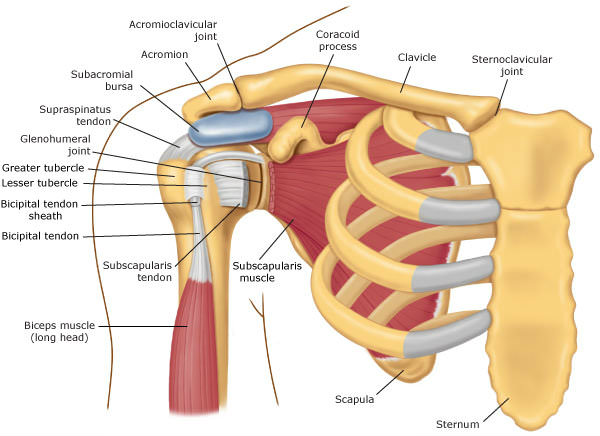
Another joint, which is considered part of the shoulder, is between the end of the clavicle (collar bone) and part of the shoulder blade. This is called the acromioclavicular joint.
The shoulder, unlike the hip, is a soft tissue joint. This means it relies for its stability and its mobility on the soft tissues such as ligaments, tendons and muscles. The shoulder has a large range of motion and little in the way of stabilising structures, making it a very mobile joint but not a stable one.
Shoulder Joint Problems
- Acromioclavicular Joint Pain. This is usually in someone between 20 and 50 years old who has a history of dislocating or part dislocating the joint during sports or overhead activities. It is common in rugby.
- Instability disorders. Mainly in people under 35 years old, there may be a history of (part) dislocation in sport or with overhead work. Vague symptoms are common and limiting, with dead arm feelings.
- Shoulder joint dislocation. Commonly caused by falling on the arm with it out to the side. Requires medical attention immediately.
- Frozen Shoulder. More common over 40 years old, in diabetics and in women. Often the cause is not clear, the condition can be severe and take a long time to settle.
- Rotator Cuff Disorders. Tend to occur in older people unless trauma is involved. Can be rotator cuff strains, rotator cuff tears or rotator cuff rupture. Sudden loss of the ability to lift the arm after trauma such as a fall should be seen urgently by an orthopaedic practitioner.
- Shoulder arthritis. Not common, it occurs in more elderly people or in people who have damaged the shoulder previously.
- Fractures may occur to any of the shoulder joint bones, including a fractured clavicle, fractured neck of the humerus or a fractured scapula (shoulder blade).
- Glenoid labrum tears. The rim around the shoulder socket may get damaged and give symptoms.
- Bursitis and tendonitis. Tendon strains or inflammation may occur in the long head of biceps tendon, the pectoralis major tendon, the supraspinatus tendon or other tendons. Bursitis may occur where someone has overused a movement greatly and inflamed the lubricating sacs between tissues.
- Post-Stroke Pain. This can be a troublesome pain that interferes with the recovery of arm function after a stroke. It typically comes on around two to three months after stroke and is thought to occur in around 30% of patients.
- Other Shoulder Conditions. These include wing scapula and suprascapular neuropathy.
- Referred pain. Referred symptoms are symptoms that are felt in one area but generated in another. In the shoulder, a common origin for pain is the neck. Neck pain should be excluded as a cause of shoulder problems.
- Stress and Tension. As many pain conditions first appear during a period of stress for the person, this stress can maintain and prolong a painful condition as the person holds themselves stiffly and moves carefully. A physiotherapist can teach people to let go of unhelpful muscle tension and patterns and encourage normal movement and function.
References:
- NICE – Shoulder pain – https://cks.nice.org.uk/shoulder-pain#!topicSummary
- Medscape. Shoulder Impingement Syndrome – https://emedicine.medscape.com/article/92974-overview
Last Review Date: 14-02-2020
Next Review Date: 14-02-2022
