
Plantar fasciitis (FASH-EE-EYE-TISS) is a foot pain condition that gives sharp and severe heel pain on weight-bearing. It often has a sudden onset and finds the sufferers limping around on their forefoot as they attempt to take pressure off the heel.
Plantar refers to the underneath of the foot, in the same way as palmar does of the hand. The pain can be severe and disabling when acute, limiting the person’s ability to get about. It is also called policeman’s heel, tennis heel and jogger’s heal. It is also referred to casually as heel spurs, but most people have a heel spur and do not have symptoms, so the spur itself is not the cause. And some people with plantar fasciitis pain do not have a spur!
Anatomy of the Plantar Area
The plantar fascia is a thick bundle of fibrous tissue that runs from a tubercle (often called a heel spur or bone spur) under the heel to the metatarsals and toes. It supports the long foot arch and absorbs shocks during walking.
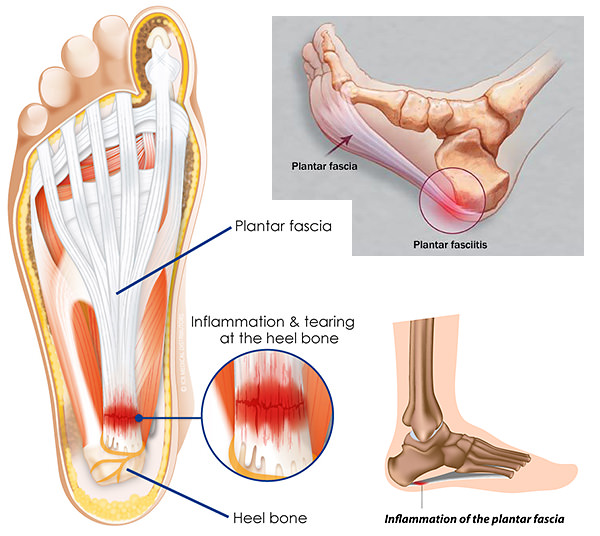
Plantar Fasciitis Pathology
The underlying mechanism is thought to be the development of microtears at the junction of the fascia and the bone, caused by the stresses of weight-bearing. It is classified as a “degenerative” condition in the same was as Achilles tendinosis or rotator cuff syndromes. Inflammation does not appear to be present, there may be reduced blood flow in the area, limiting the ability to repair the changes.
Excessive stresses on the fascia/bone junction can cause degenerative changes in the plantar fascia, setting off the condition.
Plantar Fasciitis Symptoms
- Severe, sharp pain under the front half of the heel
- Pain is worst on the first steps after getting up in the morning
- Limping, walking on the forefoot to avoid heel pressure
- Pain eases with increased activity
- Pain worsens later on in the day with prolonged activity
- Taking the load off the foot decreases the pain
- The heel may ache and the foot may feel stiff
- There may be a history of increased walking or running recently – suggesting “overuse” for that person may be relevant.
Causes of Plantar Fasciitis
The cause of this condition is unknown and may be due to a combination of factors. Overuse, defined as a recent significant increase in training or activity, may be important. As it occurs commonly in runners it is thought to be due to repeated minor trauma to the area.
A large number of factors, from incorrect training, poor footwear, prolonged standing and postural foot abnormalities have been put forward as contributory factors to plantar fasciitis. Tightness or weakness in the calf muscles and tendons, leading to reduce ankle movement, may also be important.
How Common is Plantar Fasciitis?
This is a common condition in professional athletes, occurring in around 10% of all running injuries. Women suffer plantar fasciitis around twice as much as men and the 40-60 year age group may see the most cases. It occurs more often in arthritic conditions such as ankylosing spondylitis (AS).
The Prognosis for Plantar Fasciitis (How it’s going to go)
Most people get better with conservative treatment although it can take up to a year, with only 5% needing surgery after all treatments have failed. In severe cases, patients may limp and have a limitation in running or walking.
Plantar Fasciitis Treatment
Conservative (non-surgery) treatment is usually successful in 90% of cases over time. Many therapies are used in combination for the best effect.
- Rest from the aggravating activity by modifying activities and footwear, including the use of orthotics such as insoles.
- Doctors may prescribe anti-inflammatory medication or steroid injections.
- Physiotherapy can include icing after exercise, ultrasound, plantar fasciitis exercises including stretching and muscle strengthening.
- Extracorporeal shockwave therapy (ESWT) has been shown to have some beneficial effects although the results are mixed. However, it is a low-risk treatment.
- A plantar fasciitis night splint may be used to keep the foot from flopping down as it normally does. The normal relaxed foot position can allow the plantar fascia to tighten up, giving pain again when it is stretched by standing on it in the morning. There is some evidence this can be effective, and useful in people who have had symptoms for over a year.
- Plantar fasciitis surgery – an operation called fasciotomy – the plantar fascia is cut surgically. Relief is good in up to 90% of cases but the lack of arch support can cause complications in the foot. Only about 5-10% of cases ever get to surgery, having had all the conservative treatments and not improved.
- A maintenance programme of warming up, stretching, using ice, having good footwear and replacing it regularly, for example after every 250 to 300 miles of running.
References:
Plantar Fasciitis – Clinical Knowledge Summaries. National Institute for Health and Clinical Excellence. http://cks.nice.org.uk/plantar-fasciitis#!topicsummary
Heel pain. NHS Choices. http://www.nhs.uk/conditions/heel-pain/Pages/Introduction.aspx
Plantar Fasciitis. Medscape.
Last Review Date: 25-02-2020
Next Review Date: 26-02-2022
