
The sacroiliac joint (SIJ) or SI joint is a large force transmission joint at the base of the spine. The sacroiliac joints carry the body weight from the spine above through to the pelvis and hips. Significant disagreement exists as to how important the sacroiliac joints are in back injuries and lower back pain. It is not clear that the sacroiliac joint is a source of significant pain and many physiotherapists do not think it is worth treating on its own as a pain source.
Anatomy of the Sacroiliac Joint
The sacroiliac joint is a C-shaped joint between the sacrum of the spine and the pelvis. The joint surfaces have many ridges and dips and strong ligaments that indicate it is a joint built for stability. The joint is well supplied with pain nerves from a large number of spinal nerves.
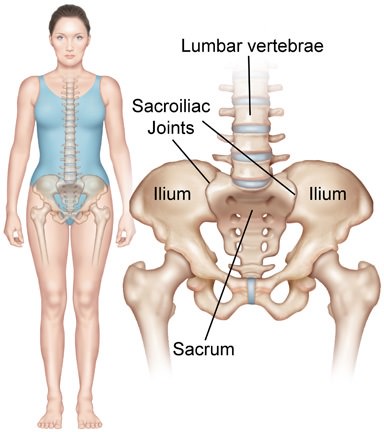
Symptoms of Sacroiliac Joint Pain
Sacroiliac joint pain is difficult to diagnose as lower back pain is very common in the same areas and sacroiliac joint pain can present in the buttocks or anywhere in the leg.
- Pain in the upper buttocks which may be achy or sharp
- Pain may appear in the buttocks, back of the thigh or further down the leg
- Pain worse on sitting or doing twisting movements
What Causes Sacroiliac Joint Pain?
As with back pain, around half of patients can identify an aggravating event that started their pain. The remainder cannot attribute it to anything. Actions or activities that could injure the sacroiliac joint have not been found. Pregnancy is known to be associated with problems with this joint.
Mechanical abnormalities such as a short leg, spinal scoliosis or hip arthritis may put repeated one-sided stresses on the sacroiliac joint, leading to joint pain. However, this hypothesis has not yet been supported by evidence.
Treatment of Sacroiliac Joint Pain
Physiotherapy is the main treatment approach for sacroiliac joint pain. Physiotherapists use heat and cold treatments, muscle energy techniques, deep tissue massage and myofascial release techniques to relieve the pain and joint problems.
Patients may have lost significant functional ability after episodes of sacroiliac joint pain so need rehabilitation. This involves correcting obvious problems such as leg length discrepancy, strengthening muscles that have become weak and stretching muscles that are tight. However, these techniques have not been shown to be effective.
Physiotherapists may then advise a long-term exercise programme in a gym or via a home programme. Encouraging the patient to adopt normal patterns of movement such as repeated lumbar flexion may be sufficient to help someone with sacroiliac/lumbar spine problems.
Medical treatments include painkillers, steroid injections into the joints and even fusion surgery in rare and serious cases. Injections can be useful diagnostic indicators as to whether the sacro-iliac joints are the cause of pain or not.
Some clinicians see the sacroiliac joint as having excessive mobility and that this excessive movement may cause pain. In this diagnosis, prolotherapy injections may be used to tighten up the ligaments of the SI joint, although no good evidence exists yet for their usefulness.
References:
- Greis A, Berk J, Gellhorn AC. Non-interventional treatment options for sacroiliac joint mediated pain: A review. OA Musculoskeletal Medicine 2013 May 01;1(1):10. http://www.oapublishinglondon.com/article/627
- Sacroiliac joint pain: a comprehensive review of epidemiology, diagnosis and treatment. Steven P Cohen , Yian Chen , Nathan J Neufeld Expert Review of Neurotherapeutics Vol. 13, Iss. 1, 2013 http://www.researchgate.net/profile/Steven_Cohen6/publication/233956961_Sacroiliac_joint_pain_a_comprehensive_review_of_epidemiology_diagnosis_and_treatment/links/00b495380abea05b01000000.pdf
Last Review Date: 11-12-2019
Next Review Date: 09-12-2021
